
Wild Salmon Without Borders - Key Insights from the 2024 Symposium in Fürstenfeldbruck
In April 2024, the annual Erlebniswelt Fliegenfischen (EWF) in Fürstenfeldbruck hosted a gathering unlike anything seen in European fly fishing. Inside the historic monastery complex, surrounded by casting ponds and bustling exhibitor halls, an entire wing of the fair shifted focus from gear and technique to something far more urgent: the survival of wild Atlantic salmon.
The symposium, titled Wild Salmon Without Borders, brought together an impressive lineup of scientists, conservation groups, river managers, international NGOs and leading fly fishers. What happened over those two days was more than a series of talks. It was a reality check, a strategy session and a call to action rolled into one. It turned the spotlight on a crisis much bigger than any fishery: the dramatic collapse of wild Atlantic salmon populations, and the urgent need for Europe-wide, collaborative action to save them.
Wild salmon conservation has always been a topic within the angling world. But the tone of this event made it clear. This is no longer a niche concern. It is a defining issue for the future of our rivers and the sport itself.
Why Wild Salmon Matter More Than Ever
Wild Atlantic salmon are more than a species. They are a measure of river health. When salmon runs collapse, it signals more profound issues: degraded habitat, blocked migration routes, declining water quality, warming streams, and rising human impacts.
Across Europe, biologists are recording dramatic drops in returning adults. Rivers that once carried tens of thousands of fish now struggle to maintain a fraction of their former populations. The speakers made one thing clear. This is a pan-European crisis, and no single country can solve it alone.
For anglers and fly fishers, this is personal. It affects our waters, our seasons, our traditions, and the very experience that draws us to the river in the first place.
Key Themes & Take-Aways from the Symposium:
1. Wild Salmon Are in Crisis and in Declining Numbers Across Borders
The core message was clear: wild Atlantic salmon populations have plummeted. Across their natural range, their numbers have dropped by more than 70 percent over the past 30 years. Some populations are now on the brink of extinction. This decline is not a regional quirk — it is a catastrophe affecting rivers from Spain to Iceland, from the UK to Scandinavia.
Experts from the UK, Ireland, Norway, Iceland, Spain, France, Denmark and Germany shared data showing the same trend: steep declines in returning salmon. Whether driven by ocean pressures or river degradation, the pattern is widespread.
And that is precisely why the symposium emphasized international cooperation.
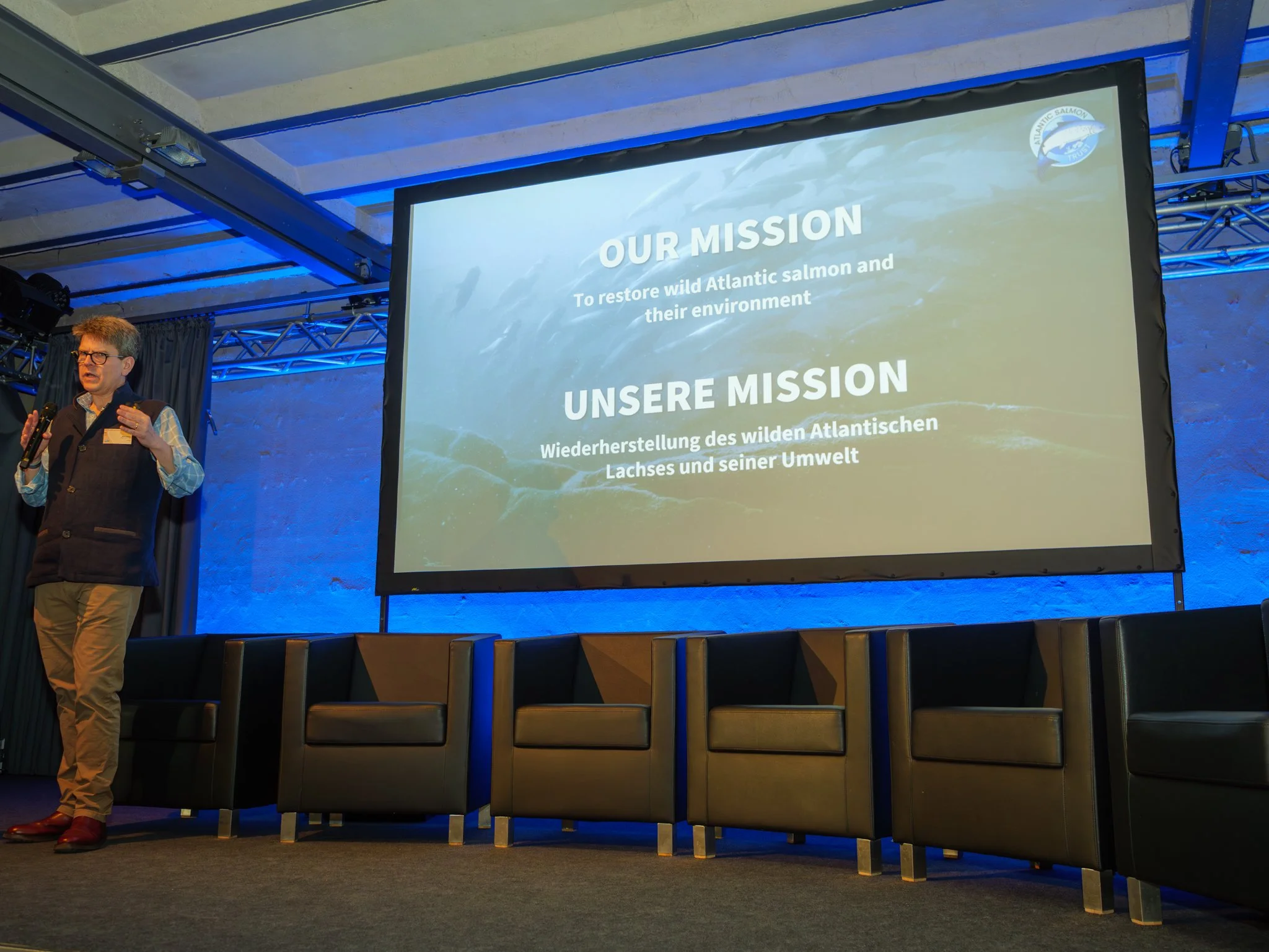
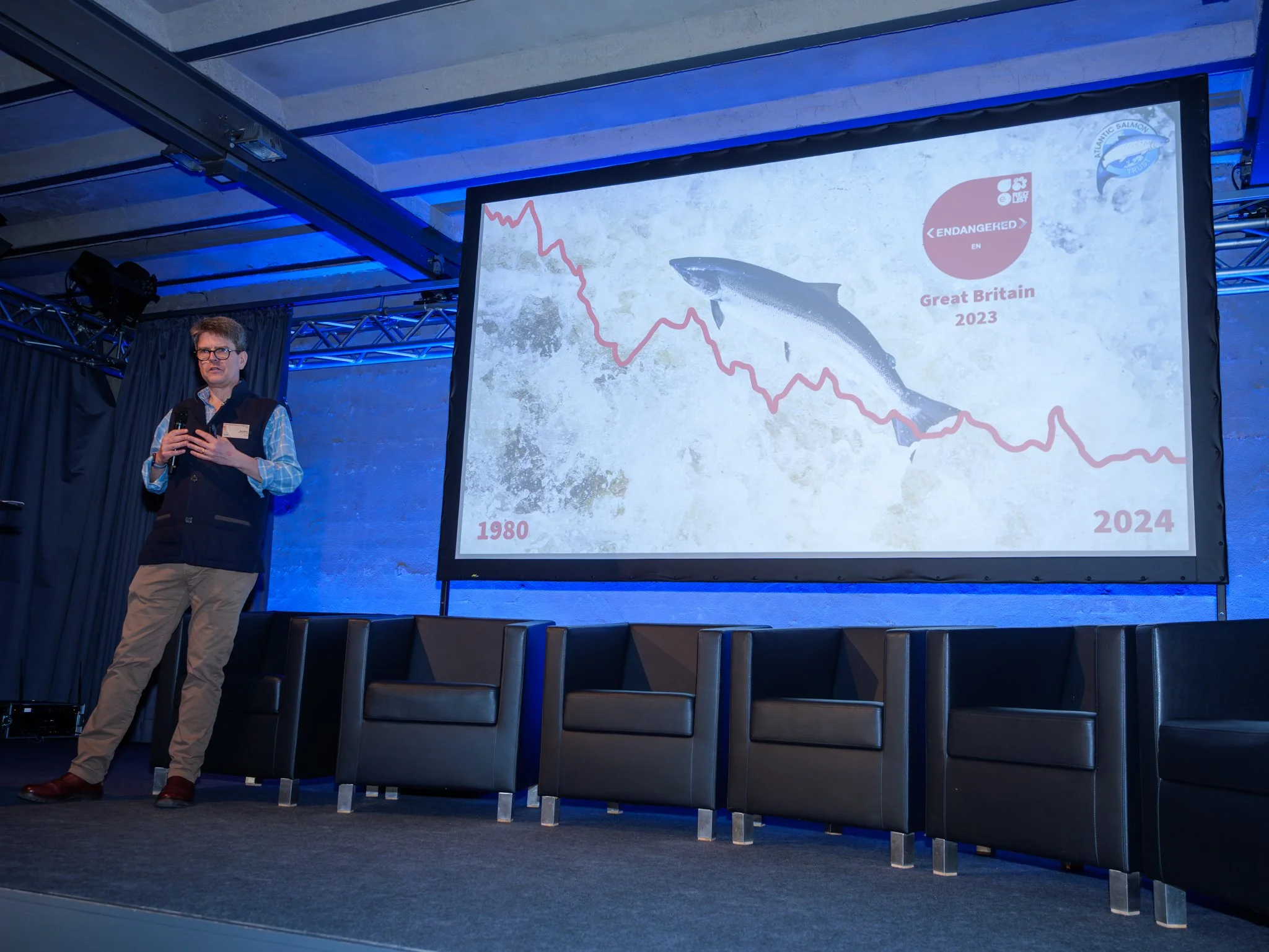
2. Habitat Destruction, Barriers, and Disrupted Migration Must Be Reversed
One of the most urgent tasks is restoring natural river habitats and removing barriers that block salmon migration. Many rivers that once teemed with salmon are now fragmented by dams, weirs or other obstacles that salmon cannot pass, preventing them from reaching spawning grounds.
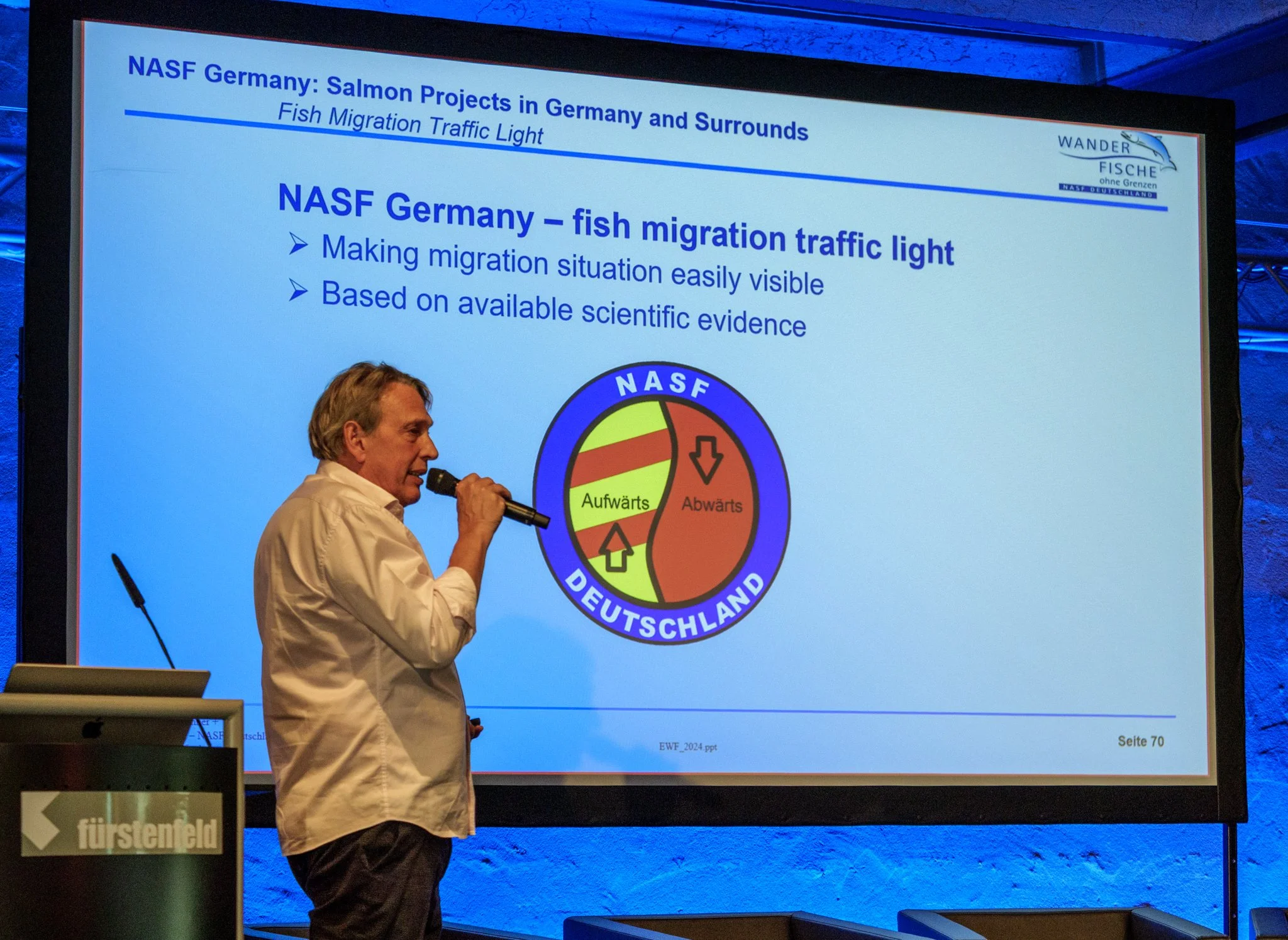
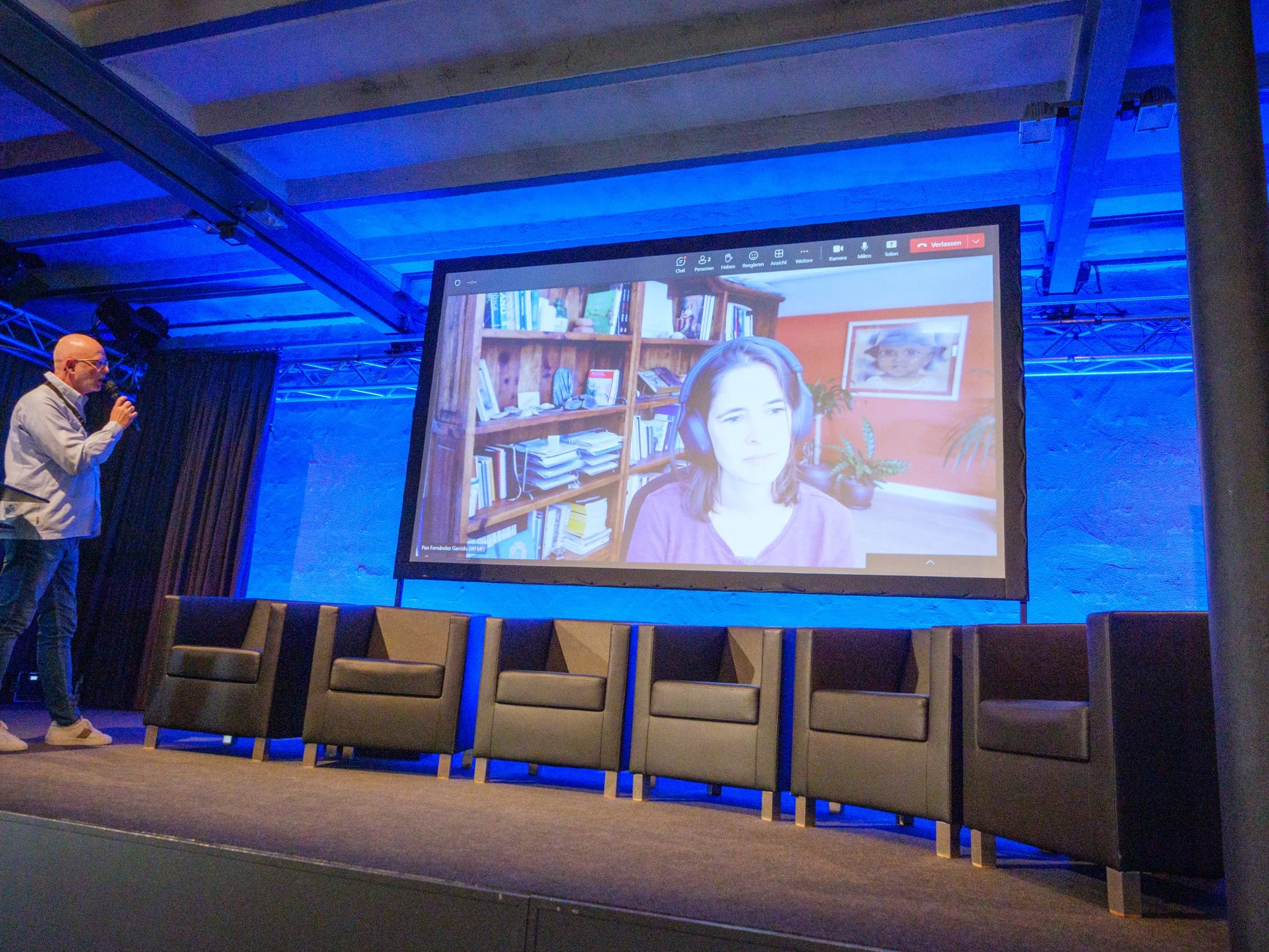
Barrier removal emerged as a central theme. Millions of European river obstacles block migration, many outdated or abandoned. Presentations highlighted how reconnecting just a few key tributaries can dramatically improve salmon survival.
Speakers underscored the necessity for cross-border cooperation: salmon don’t care for political divisions — their survival depends on the health of entire river systems across Europe.
Projects in Denmark and Scotland showed measurable success after habitat restoration and improved fish passage.
3. Open-Pen Salmon Farming Poses a Major Threat
The symposium did not shy away from controversial topics. The impact of open-pen salmon farming was raised as a serious concern. Escapees, genetic mixing, disease transmission, and pollution all pose risks to the fragile remaining wild salmon stocks.
Several talks focused on Iceland and Norway, where open-net aquaculture has introduced sea lice, pollution, and genetic dilution into wild stocks. The message was consistent and underpinned by the airing of the short film „Laxaþjóð | A Salmon Nation“ by Patagonia Films.
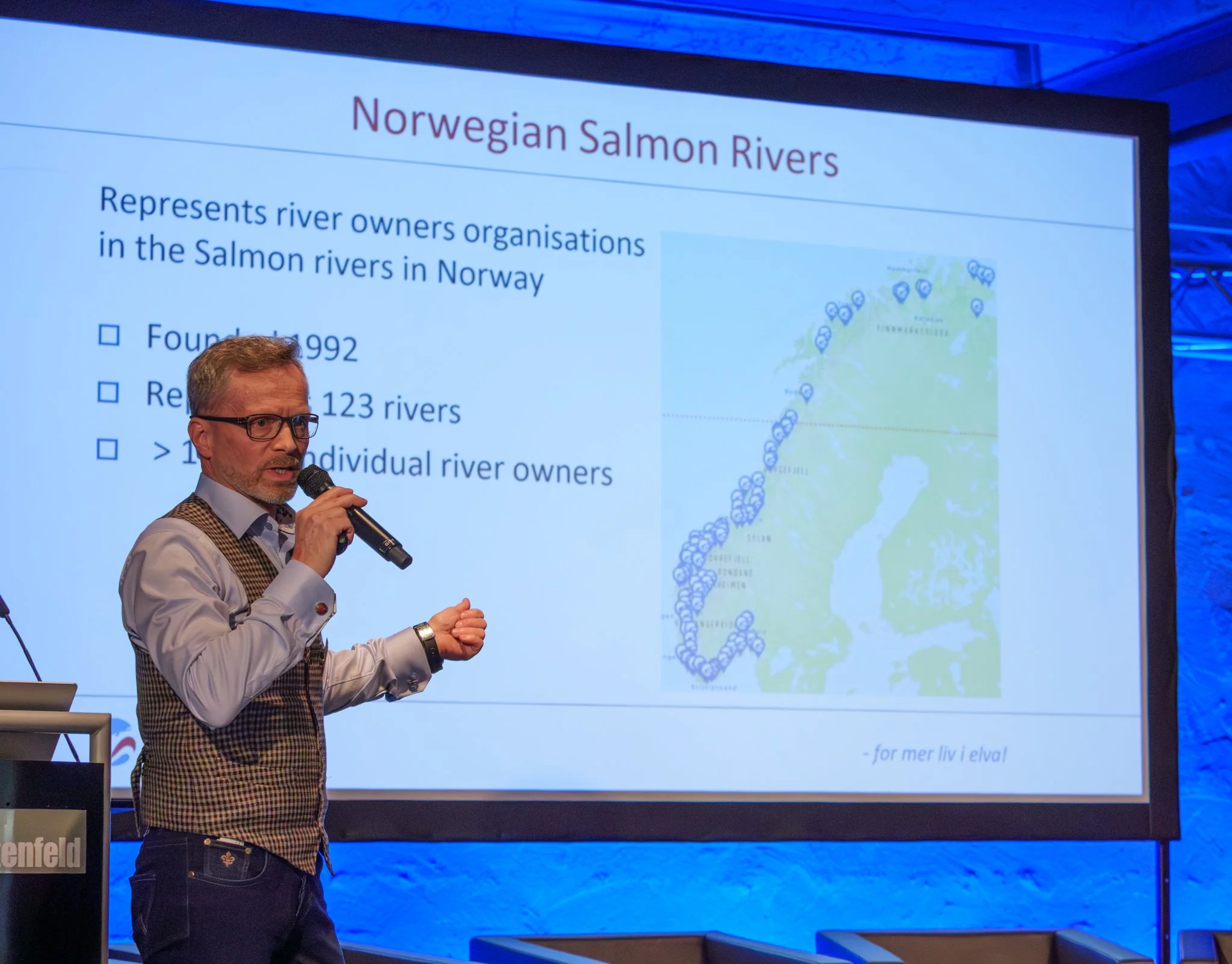
Nils Olav Gjone, Norske Lakseelver
Can we save wild salmon and have a sustainable aquaculture industry for the future?
Without meaningful change, wild salmon will continue to bear the cost. These issues demand not just local regulation, but international attention — after all, salmon travel great distances, and their fate spans national boundaries.
I will follow up with a later conservation blog on the issues of Open-Pen Salmon Faming so stay tuned!
4. Cultural and Spiritual Significance of Wild Salmon
Conservation at the symposium wasn’t framed purely in ecological terms. Speakers and film-makers pointed out that wild salmon carry deep cultural and spiritual importance for communities across Europe — not only as game fish, but as part of a shared natural heritage.
Films shown throughout the symposium—such as Salmo, Wild Summon and Patagonia’s Laxaþjóð: A Salmon Nation reminded attendees that salmon shape communities, histories, and even national identity by putting an emotional lens on the crisis
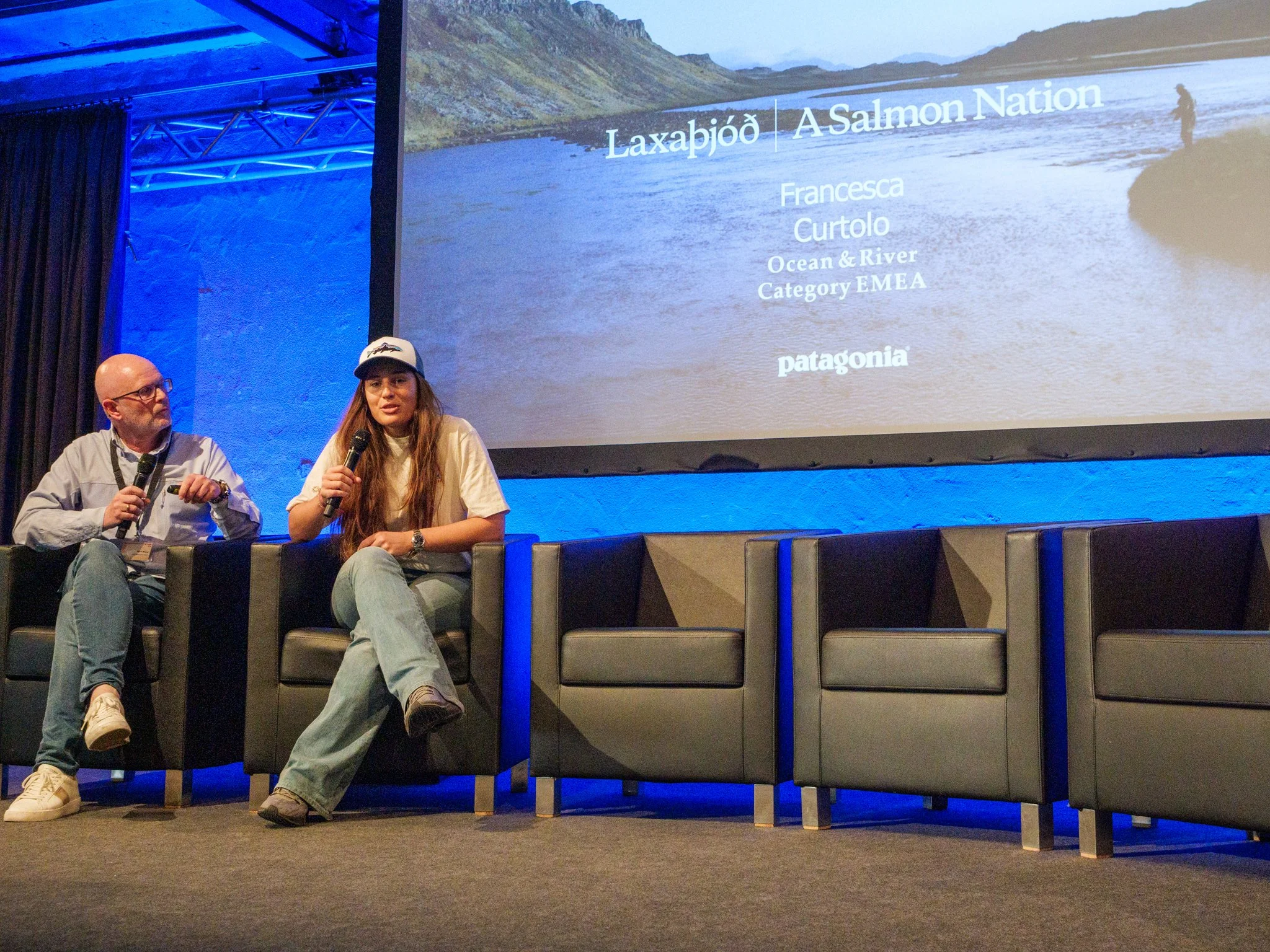
Bernd Bieber — Event Host & Francesca Curtolo — Patagonia Europe
„Laxaþjóð | A Salmon Nation“ by Patagonia Films.
Through these films, animations, and stories, attendees were reminded: saving wild salmon isn’t just about numbers and biology — it’s about preserving a living connection between people and their rivers, their history, and their identity.
5. Shared Responsibility—Anglers as Stewards, Not Just Sportsmen
A dedicated panel brought together well-known anglers to discuss stewardship. Their strongest recurring message was that anglers themselves have a crucial role to play. The panel and the symposium urged responsible fishing practices, catch-and-release where appropriate, and engagement in habitat restoration rather than merely exploitation.
Moreover, the spirit of cooperation was not limited to conservationists—recreational anglers, environmental organizations, and government-level stakeholders need to work together. The symposium set out to build those bridges.
What Happened Next—A Starting Point, Not the Finish Line
The “Wild Salmon Without Borders” symposium was more than a series of speeches: it was the launchpad for a Europe-wide movement. The organizers, the Atlantic Salmon Trust (AST), together with EWF and various partners, laid the groundwork for cross-national alliances.
Already during the symposium, films like Laxaþjóð: A Salmon Nation (about salmon farming in Iceland), Wild Summon, and Salmo drew attention to the stakes—and motivated many attendees deeply.
Since the event, efforts have continued: fundraising, awareness campaigns, and concrete plans for habitat restoration have been put into motion. The symposium became a stepping stone toward broader collaboration under new banners—for example, the follow-up initiative Wild Salmon Connections in January 2025.
Why This Matters—For Rivers, for People, for the Future
Wild salmon aren’t just another species on a checklist. They symbolize the health of entire river systems. Their decline signals deep environmental trouble: poor water quality, disrupted ecosystems, and shrinking biodiversity.
Protecting salmon is about preserving waterways—for other fish, for insects, for birds, and ultimately for people. Restored rivers mean healthier ecosystems, better water quality, and more resilient nature in the face of climate change.
At the same time, salmon embody a shared European heritage. Their migrations once connected remote fjords, highlands, mountain streams, and lowland rivers—from Scotland to Spain, from Iceland to Germany. The effort to save them brings people and nations together on a common task.
A Call to Action for Everyone—What You Can Do
If you believe in wild salmon—if you care about rivers, biodiversity, and heritage—you don’t need to wait for governments. Here’s what you can do to contribute:
Support organizations like the Atlantic Salmon Trust, or local conservation bodies. Even small donations help fund restoration, research, and advocacy.
Practice sustainable angling: if you fish, consider catch-and-release policies, use barbless hooks, respect spawning seasons, and avoid sensitive spawning grounds.
Raise awareness: talk with fellow anglers, friends, or family. Share the story of wild salmon decline and the importance of habitat restoration.
Get involved locally: whether it’s a river clean-up, a citizen science water-quality test, or petitioning for barrier removal—local action adds up.
Push for systemic change: support policies and regulations that curb harmful aquaculture, improve water quality, and protect migratory routes.
Stop or avoid consuming farmed salmon and encourage others to do the same
A Specific Request to Anglers and Fly Fishers
If you step into a river with a fly rod, this concerns you. The future of salmon fishing depends on the survival of the fish themselves. And right now, they need our help.
Here is my ask:
Become part of the solution.
Support river restoration projects. Fish responsibly. Learn your local river’s challenges. Encourage others to treat fish and water with care. Speak up when you see something wrong. Volunteer if you can. Even small actions add up in ways that matter.
When anglers lead, others follow.
How You Can Support Wild Salmon
• Support science-based NGOs.
• Practice ethical catch-and-release.
• Avoid fishing near active redds.
• Join habitat projects or river cleanups.
• Advocate for better aquaculture policies.
• Share information within your fishing community.
Restoring salmon means restoring rivers, and restoring rivers enriches every species that depends on them—including us.
My Final Thoughts
The “Wild Salmon Without Borders” symposium wasn’t a feel-good brochure for anglers—it was a warning bell and a call to arms. It reminded us that what we do by the water, every time we cast a line, affects more than a single fish.
But it also offered hope: hope that with cooperation, commitment, and collective will, we can still turn the tide. Not just for salmon, but for rivers, ecosystems, and future generations who deserve wild, living waterways.
Maybe next time you hold a fly rod, you won’t just think about the catch—you'll think about the river’s deepest story. And about the salmon that belong there.
Sources, Speakers/Presenters, Links, Contributors, and Organizations
The strength of the symposium came from the range of expertise represented. Below is an integrated overview of the confirmed speakers, panelists, and groups involved.
Featured Speakers, Contributors and Their Topics:
Mark Bilsby, Atlantic Salmon Trust - Welcome to Wild Salmon Without Borders
Alison Baker, Atlantic Salmon Trust - What Salmon Need to Thrive: Cold Clean Water
Stefan Ludwig, NASF Deutschland / Wanderfische ohne Grenzen - Atlantic Salmon in Germany – Yesterday, Today and Tomorrow
Pao Fernández Garrido, World Fish Migration Foundation - Removing Barriers to Fish Migration in Europe
Elvar Örn Fridriksson, NASF Iceland - The Fight Against Open Net Pen Salmon Farming in Iceland
Dr Wendy Kenyon, Missing Salmon Alliance / AST - Wild Salmon Connections: International Collaboration for Wild Salmon
Imke Teuffel, Fario e. V. - It Started with a Dream – Fly Fishing and Nature Conservation
Gert Holdensgaard, Center for Vildlaks, Denmark - Rehabilitation of Danish Salmon Stocks – 30 Years of Success
John Olav Oldren, Verdal (Norway) - Assisting Migration Passage for Wild Atlantic Salmon
Bernd Bieber - Event Host
Francesca Curtolo - Patagonia Europe
Panel and Angling Panel Contributors
• Klaus Frimor
• Paddy McDonnell
• Tom Brown
• Thomas Knutsen
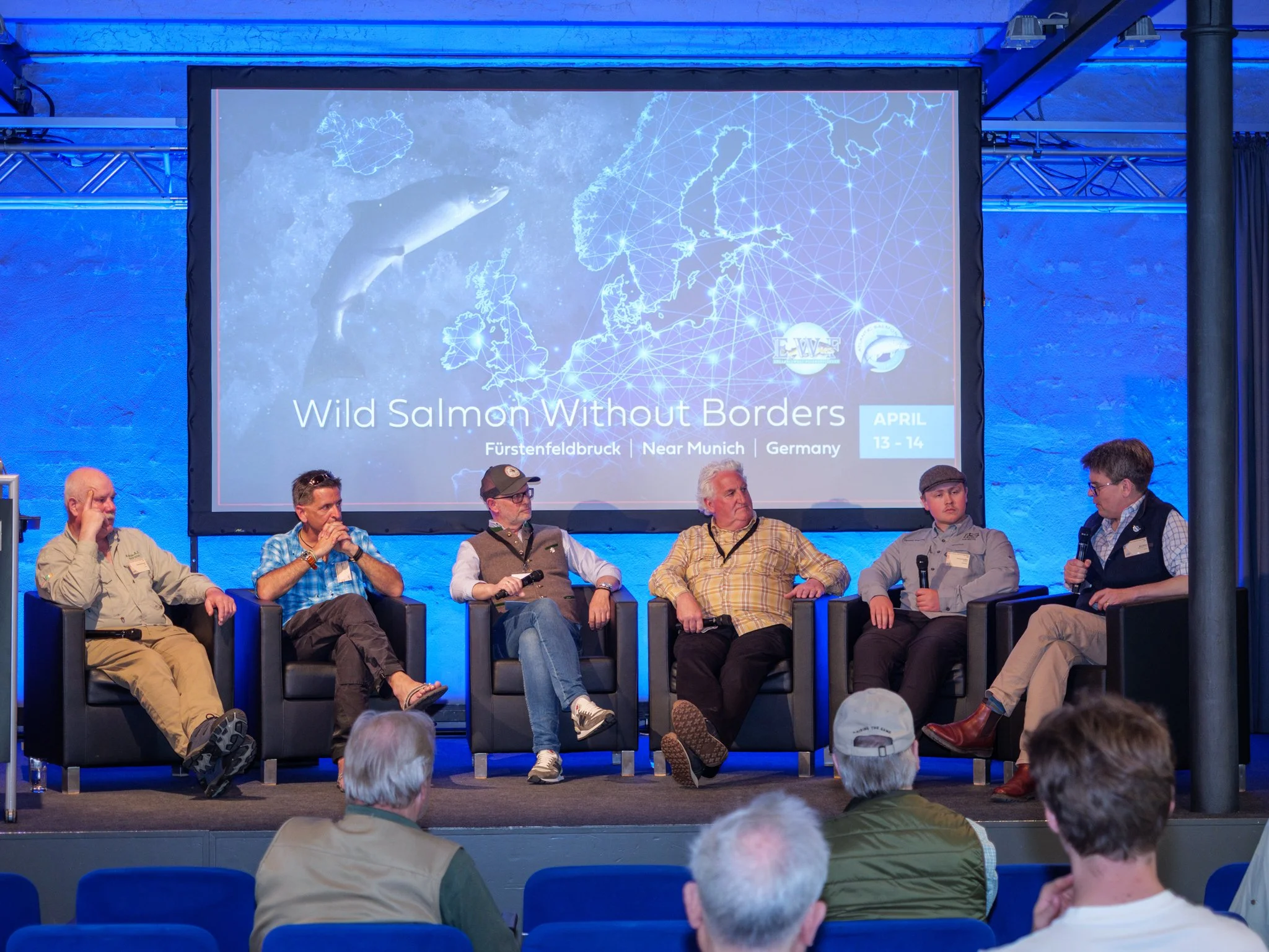
Panel Participants left to right: Paddy McDonnell, Klaus Frimor, Bernd Bieber, Tom Brown, Thomas Knutsen, Mark Bilsby
These voices ensured that conservation wasn’t treated as a purely academic topic. It stayed grounded in the everyday realities of fly fishers.
Film - Media People - Organisation Role at symposium
Cold Clean Water – The Project Deveron Story - Atlantic Salmon Trust Film shown both days, illustrating habitat restoration work.
Salmo - Paul Pajot - French animated short film screened both days.
Wild Summon - Karni Arieli & Saul Freed BAFTA-nominated - Oscar-shortlisted animated film shown as part of the programme.
Laxaþjóð | A Salmon Nation - Patagonia Film - Discussion session about salmon farming impacts in Iceland.
Sources and Links:
Wild Salmon Without Borders symposium - https://atlanticsalmontrust.org/wild-salmon-without-borders/
EWF Fürstenfeldbruck event information - https://www.erlebniswelt-fliegenfischen.de
EWF Event updates and follow-up actions - https://www.erlebniswelt-fliegenfischen.de/index.php/en/news-eng
Agenda and Info from the symposium: https://atlanticsalmontrust.org/wild-salmon-without-borders/
Summary Video from the Event:
Main organizations represented as presenters or partners
Atlantic Salmon Trust (AST) – main coordinating partner and multiple speakers.
North Atlantic Salmon Fund (NASF) – represented through NASF Iceland and NASF Deutschland (Wanderfische ohne Grenzen e. V.).
Wanderfische ohne Grenzen e. V. / NASF Deutschland – German wild salmon NGO, with a talk focussed on Atlantic salmon in Germany.
World Fish Migration Foundation – focused on barrier removal and fish passage.
Norske Lakseelver – Norwegian river and salmon association.
Center for Vildlaks (Denmark) – Danish centre for wild salmon restoration.
Fario e. V. – German association whose participation at the symposium is described as the starting point for its wider work on river restoration and hatcheries in Brandenburg.
Patagonia – provided the film Laxaþjóð: A Salmon Nation and took part in the related discussion.
Missing Salmon Alliance – via Dr Wendy Kenyon’s talk on Wild Salmon Connections.
DAFV (Deutscher Angelfischerverband e. V.) – not as a speaker, but as Germany’s national angling federation highlighting and promoting the symposium as a springboard for international cooperation.
EWF - Erlebnisswelt Fliegenfischen — host for the Symposium
You can safely describe the symposium as a gathering of European wild salmon NGOs, river managers, scientists, and angling organizations, anchored by AST and EWF.
Speaker Bios: Who Shaped the Symposium
Mark Bilsby—Atlantic Salmon Trust (AST)
Mark leads AST with a focus on science-driven conservation and practical river restoration. His work connects researchers, policymakers, and anglers to rebuild salmon runs across the North Atlantic.
Alison Baker—Atlantic Salmon Trust
Alison specializes in cold-water ecology and watershed health. She studies how temperature, flow and habitat quality influence salmon survival from headwaters to estuary.
Stefan Ludwig—NASF Deutschland / Wanderfische ohne Grenzen e. V.
A leading voice for salmon recovery in Germany, Stefan works on river rehabilitation, advocacy, and public engagement. His focus is reconnecting Germans with their lost salmon heritage.
Pao Fernández Garrido – World Fish Migration Foundation
Pao is one of Europe’s strongest advocates for removing obsolete river barriers. Her work spans mapping, policy, and hands-on restoration to reopen migration routes for fish across the continent.
Elvar Örn Fridriksson – NASF Iceland
Elvar addresses the challenges posed by open-pen aquaculture. He works to protect Iceland’s wild salmon stocks from genetic mixing, parasites and escapees.
Dr Wendy Kenyon—Missing Salmon Alliance / AST
Wendy leads collaborative research efforts across Europe and the UK. Her work bridges science and policy, pushing for coordinated salmon recovery strategies that cross national borders.
Imke Teuffel – Fario e. V.
Imke represents a new generation of German conservationists. Her work focuses on the connection between fly fishing and hands-on river stewardship, including habitat projects and youth engagement.
Gert Holdensgaard – Center for Vildlaks (Denmark)
A key figure in Denmark’s salmon success story, Gert has helped engineer one of Europe’s most effective long-term salmon restoration models, proving that recovery is possible with the right strategy.
John Olav Oldren – Verdal (Norway)
John manages salmon rivers in the Trondheimfjord region. His field-based work includes designing and improving migration passages to support wild salmon returning from the sea.
Klaus Frimor – Fly Fishing Ambassador & Panelist
Known across Europe for modern Scandinavian casting techniques, Klaus also advocates for river stewardship and responsible salmon fishing.
Paddy McDonnell – Angler & Conservation Voice
Paddy brings decades of experience on the water. He champions ethical angling and community-based river protection.
Tom Brown – Guide & Conservation Panelist
Tom combines guiding experience with a practical understanding of salmon behavior and angler responsibility.
Thomas Knutsen – Norwegian Fly Tier & Conservation Panelist
Thomas is known for traditional Norwegian salmon flies and supports grassroots conservation efforts in his home rivers.
Francesca Curtolo — Patagonia Europe
Fish & Surf Category Manager at Patagonia intoducing the film: Laxaþjóð | A Salmon Nation by Patagonia